
Course Search Autocomplete
Free & ProAs a student types in the course catalog search box, Learnomy shows a live dropdown of matching course names so they can jump straight to a course instead of waiting for a full page of results.
What you can do
- Find a course by typing part of its title and picking it from a dropdown, without pressing Enter or loading a results page.
- Get results after only two characters, updated as you keep typing.
- Click any suggestion to go directly to that course's detail page.
- Still run a full catalog search: pressing Enter submits the search form and the server re-renders the filtered grid, using the same query the suggestions came from, so the dropdown and the results page always agree.
- See a clear "Searching..." state while matches load and a "No matching courses" message when nothing matches.
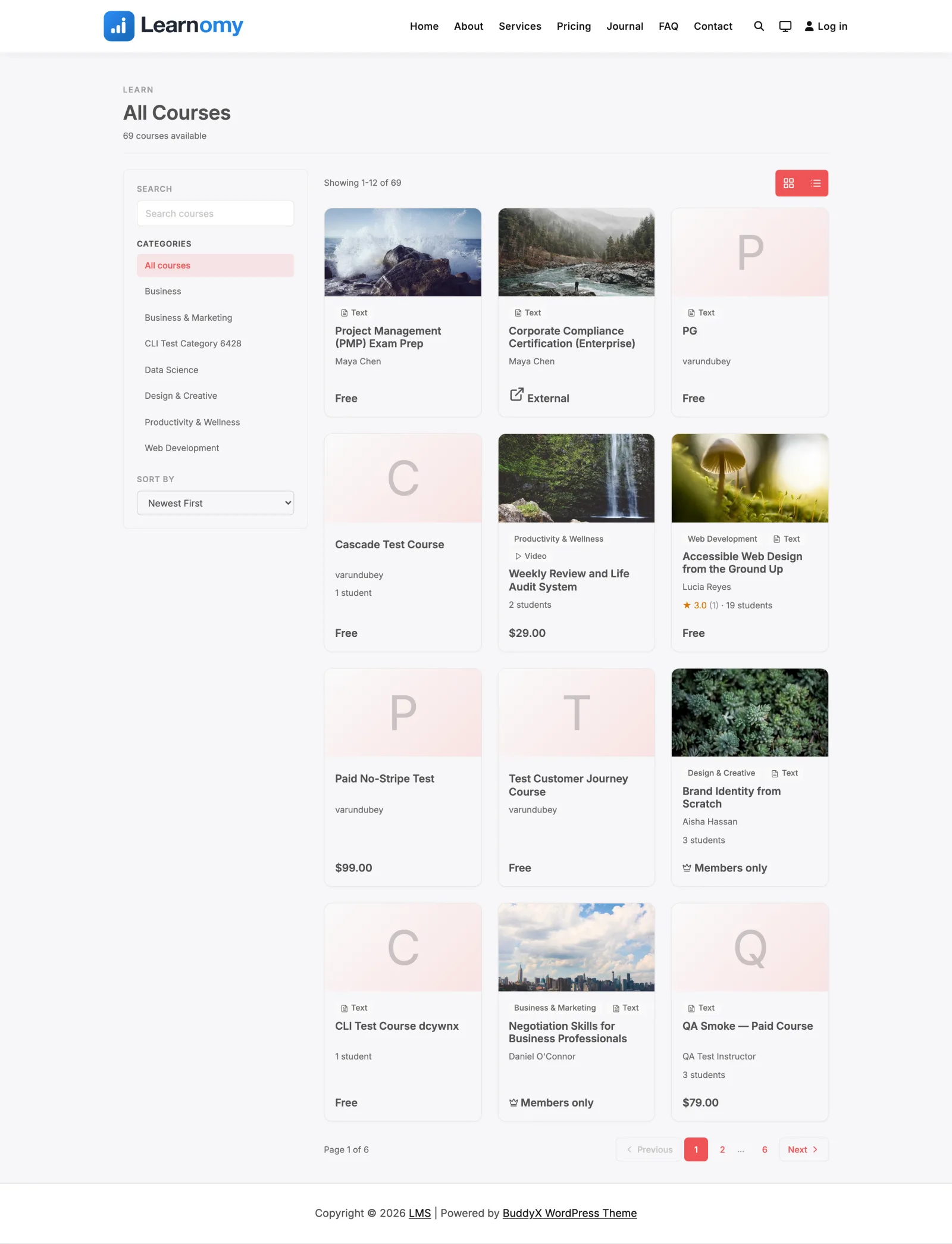
How to use it
- Go to the course catalog at
/courses/. The search box appears in the left filter sidebar (labelled "Search") and, in the top filter bar variant, above the course grid. - Start typing a course name. Once you have typed at least two characters, a dropdown opens below the box.
- Wait a moment. Typing is debounced, so Learnomy waits briefly after your last keystroke and then fetches up to six matching courses. While it loads, the dropdown shows "Searching...".
- Read the suggestions. Each row is a matching course title. If nothing matches, the dropdown shows "No matching courses".
- Click a suggestion to open that course's detail page directly.
- Or press Enter to submit the full search. The catalog reloads showing every matching course in the grid, not just the first six.
- Click away from the box to close the dropdown. Returning focus to the box (with two or more characters still typed) reopens the last set of suggestions.
Settings & options
This feature works out of the box on the catalog and has no dedicated admin settings screen. The values it uses are:
- Minimum characters - the dropdown starts fetching at two characters. Below two characters it stays closed.
- Suggestion count - up to six courses are shown in the dropdown. The suggestion request is
GET /learnomy/v1/courseswith thesearchandlimit(6) parameters. - Search field - the catalog search input uses the query parameter
s, hasautocomplete="off", and reuses the same course search as the full results page. Matching uses the course FULLTEXT search with a prefix wildcard, so "mind" finds "Mindful". - Dropdown messages - the "Searching..." and "No matching courses" labels come from
window.lrnCatalog.i18n(searchingandnoResults), so they are translatable. - Suggestion links - each suggestion's URL is built from
window.lrnCatalog.courseUrlTemplate, which resolves to the course route for the matched slug.
For developers
- REST endpoint: suggestions are fetched from
GET /learnomy/v1/courses?search=<query>&limit=6(namespacelearnomy/v1), the same endpoint the catalog grid uses. - Interactivity store: the behaviour lives in the
learnomy/catalogstore (assets/js/catalog-view.js). Relevant actions aresearch(debounced input handler),fetchSuggestions,openSuggestions, andhideSuggestions; state keys includesuggestions,suggestOpen,suggestLoading, and thesuggestVisible/suggestEmpty/suggestStatusLabelgetters. - Template: the dropdown markup is
templates/catalog/partials/search-suggest.php(arole="listbox"withrole="option"items), included by bothtemplates/catalog/sidebar.phpandtemplates/catalog/grid.php. It is overridable from a theme attheme/learnomy/catalog/partials/search-suggest.php. - Search backend: matching runs through the course FULLTEXT search over
lrn_courses(title plus thedescription_plainprojection). - Catalog slug: the
/courses/base is filterable vialearnomy_base_slug(see\Learnomy\base_slug()inincludes/functions.php, which thecatalogroute binds to); suggestion links are built through\Learnomy\route_url( 'course', [ 'slug' => ... ] ).